All applications
Gatherer app icon

Application · Literature workflow

Gatherer

Oncology guideline and landmark-trial acquisition.

Gatherer builds and maintains a structured oncology reference library — on local disk or in Dropbox. It mirrors the ESMO guideline hierarchy as a folder tree, retrieves guideline PDFs and keeps them current, and assembles the landmark-trial literature for each tumour entity — verifying every publication against PubMed and resolving an open-access copy through Unpaywall before falling back to a browser-based fetch for free-to-read sources that block automated download.

Gatherer is a private educational and reference workflow tool. It does not make treatment recommendations or determine standard of care, and any language-model output is used only to propose candidate publications for manual review. Aerodromic is independent and is not affiliated with or endorsed by ESMO or any other organisation named here.

macOS desktop app Python · PySide6 PubMed · Unpaywall Dropbox LLM-assisted

Capabilities

Four functions, one curated workflow

01

Mirrors the guideline structure

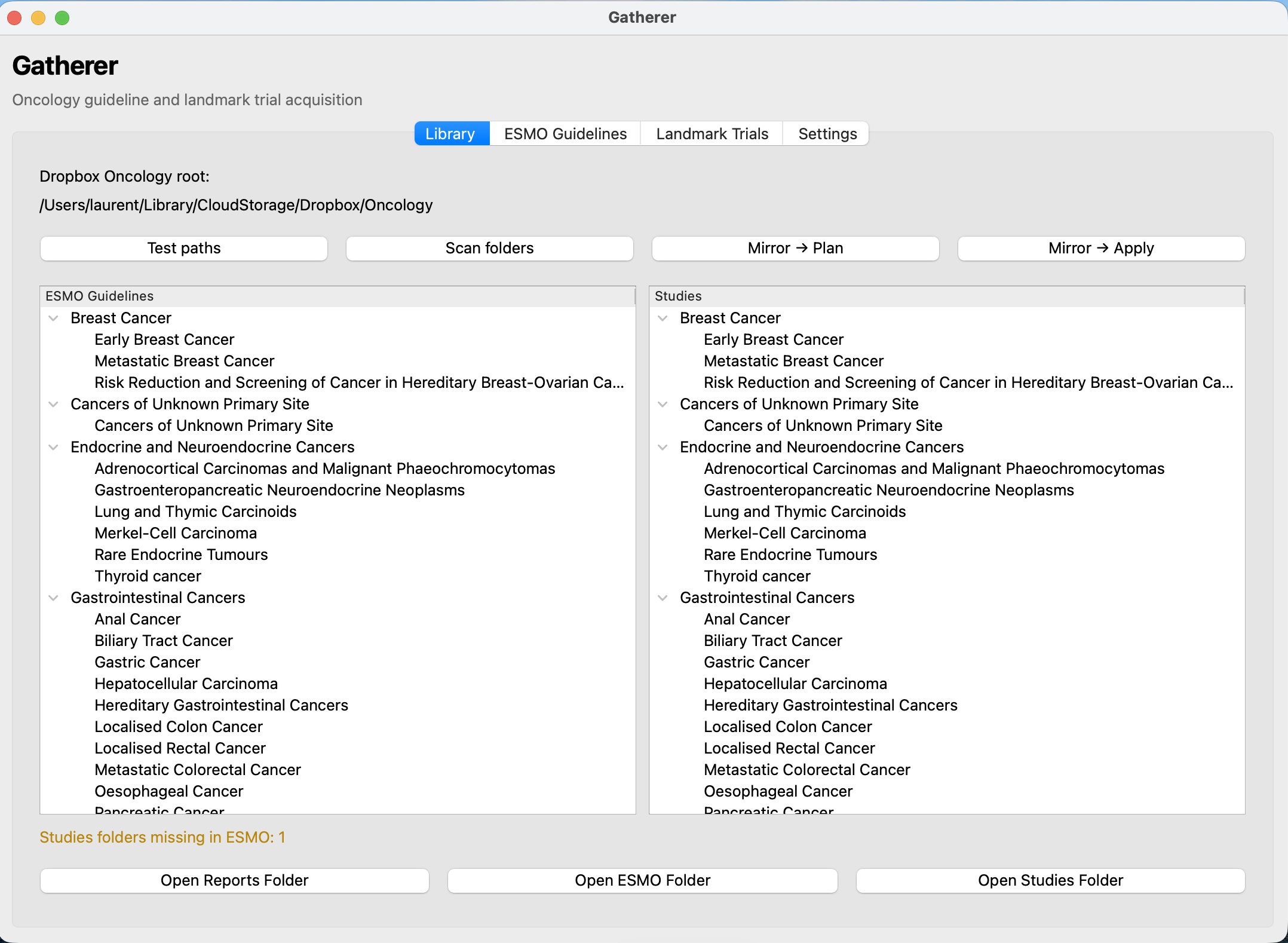
Gatherer derives the hierarchy ESMO uses to organise its clinical practice guidelines — for example, Breast Cancer → Early Breast Cancer, or Gastrointestinal Cancers → Colorectal Cancer — and reproduces it as a local folder tree. The structure stays readable outside the app and syncs cleanly through Dropbox.

02

Retrieves and updates guideline PDFs

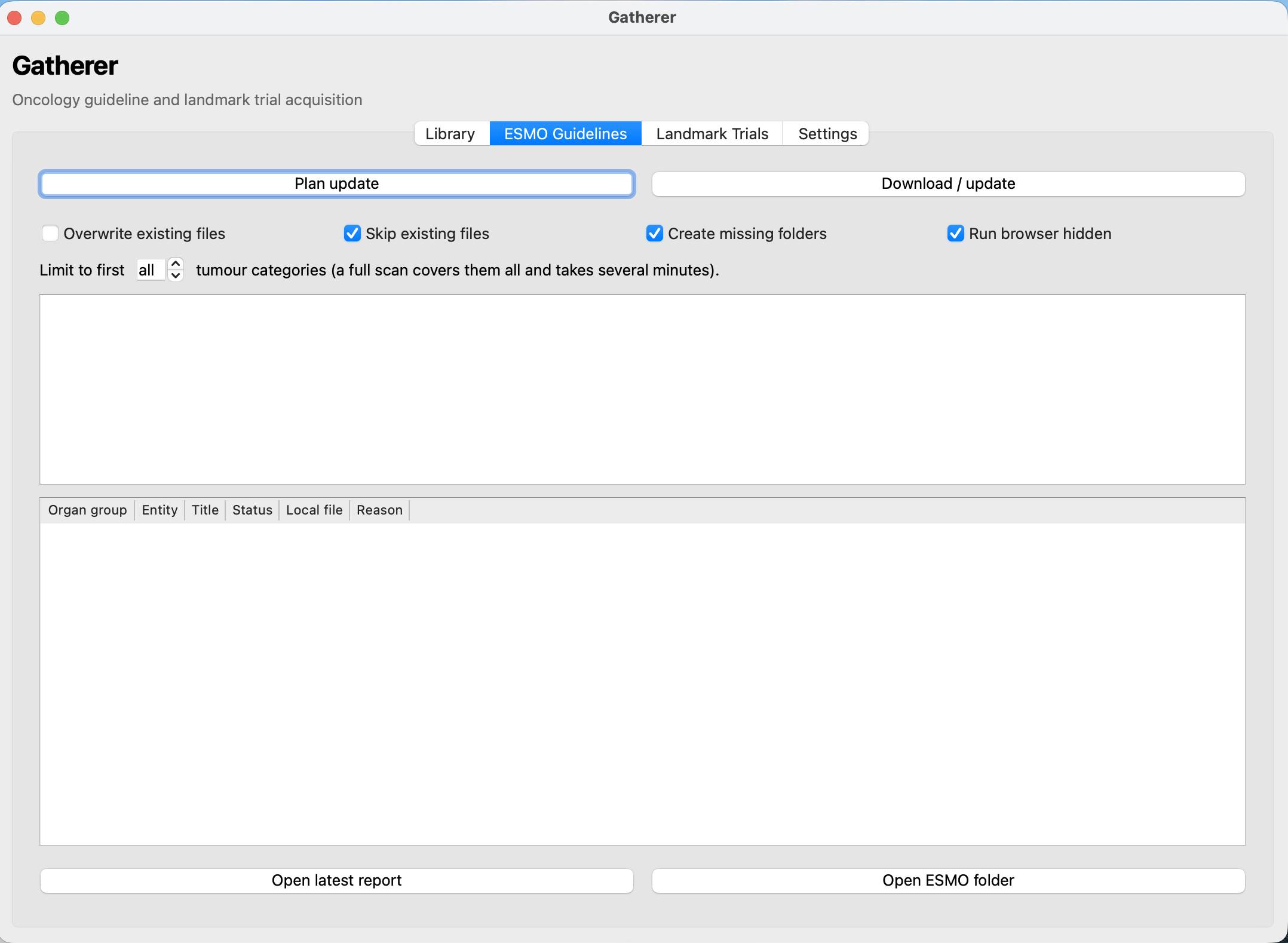
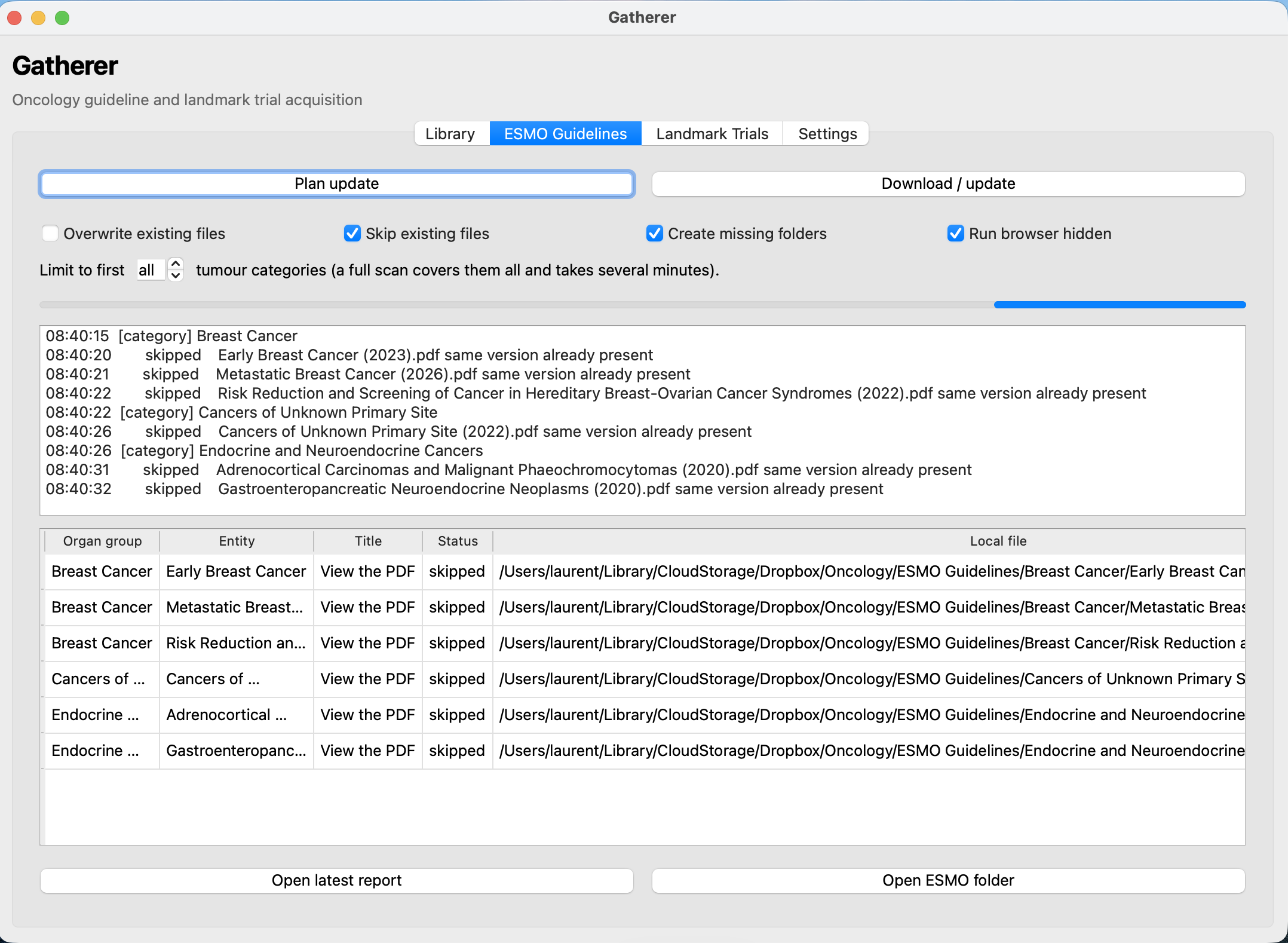
For each tumour entity, Gatherer downloads the corresponding ESMO guideline PDFs into the matching folder. It compares local files against the current ESMO release, retrieves newer versions as they are published, and leaves files that are already current untouched.

03

Acquires landmark-trial literature

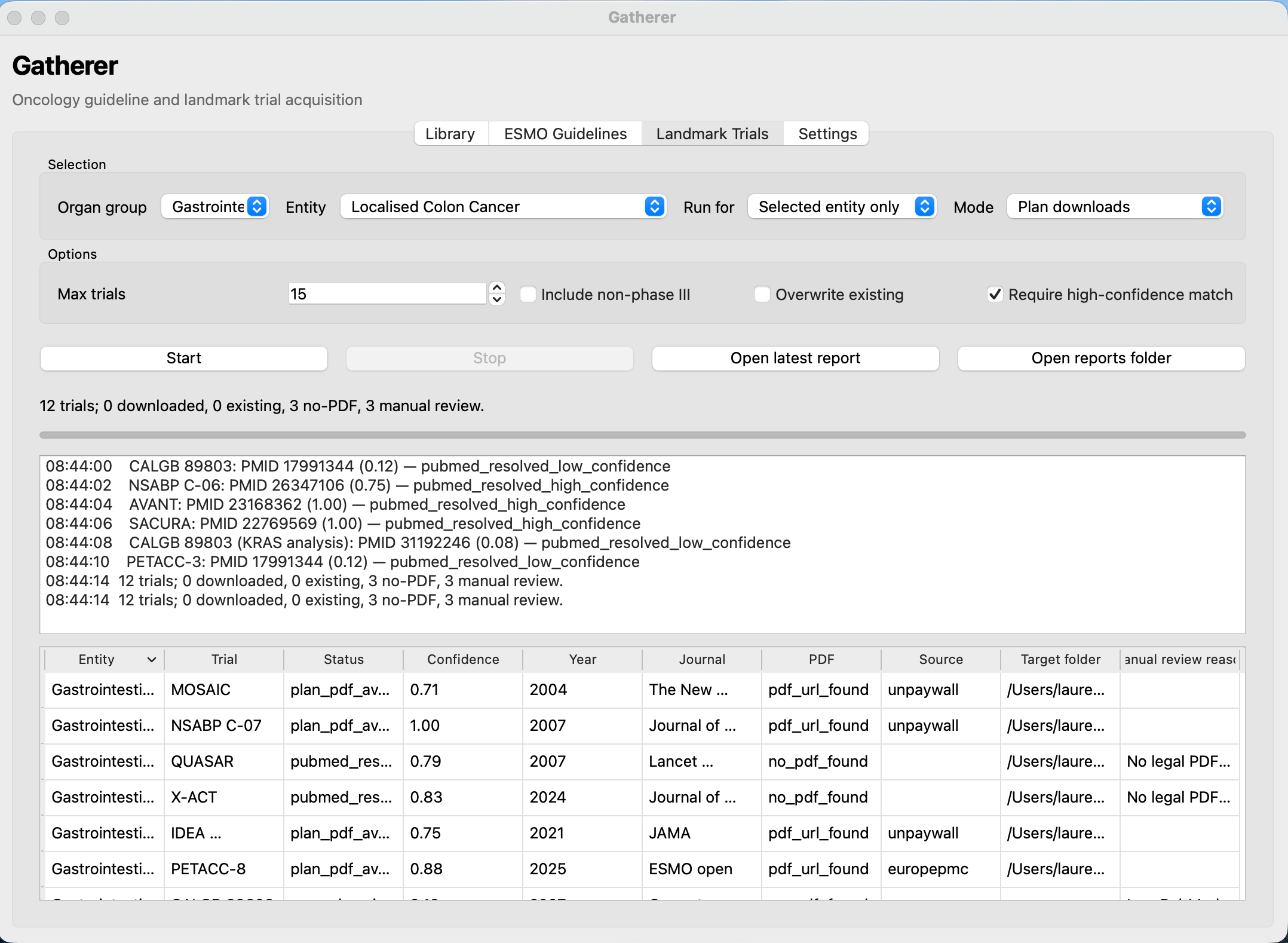
For a selected tumour entity, Gatherer assembles the landmark-trial PDFs. It verifies each candidate against PubMed and resolves an open-access copy through Unpaywall, Europe PMC and Crossref; where a source is free to read but blocks automated download, it fetches the file through a real browser session. Anything it cannot retrieve is flagged for manual review with a direct link.

04

A language model proposes; the user curates

A language model proposes candidate landmark trials for an entity as a starting point, not a final list. Every suggestion is verified against PubMed, and the library remains curated by the user. Gatherer does not infer clinical conclusions or decide which studies are practice-changing.

How it works

From source literature to a structured library

01 · Structure Derive ESMO's guideline hierarchy and create or update the local folder tree.
02 · Guidelines Retrieve guideline PDFs into the matching tumour-entity folder; skip files already current.
03 · Trials Resolve landmark-trial publications: PubMed → Unpaywall / Europe PMC / Crossref → browser fetch, with a manual link as fallback.
04 · Review Keep the final library curated and ready to browse, search and open (e.g. in the companion Anvil reader).

Interface

Inside the application

A native macOS interface across the full workflow.

Gatherer Library tab showing the mirrored ESMO folder tree
Library — the ESMO guideline tree reproduced as local folders, with any gaps flagged.
ESMO Guidelines update plan
ESMO Guidelines — an update is planned; files already at the latest version are skipped.
ESMO Guidelines update running
A run in progress — current files skipped, new versions retrieved.
Landmark Trials results with confidence scores
Landmark Trials — each candidate verified against PubMed and resolved through Unpaywall, with a confidence score and a manual-review link where no PDF could be retrieved.
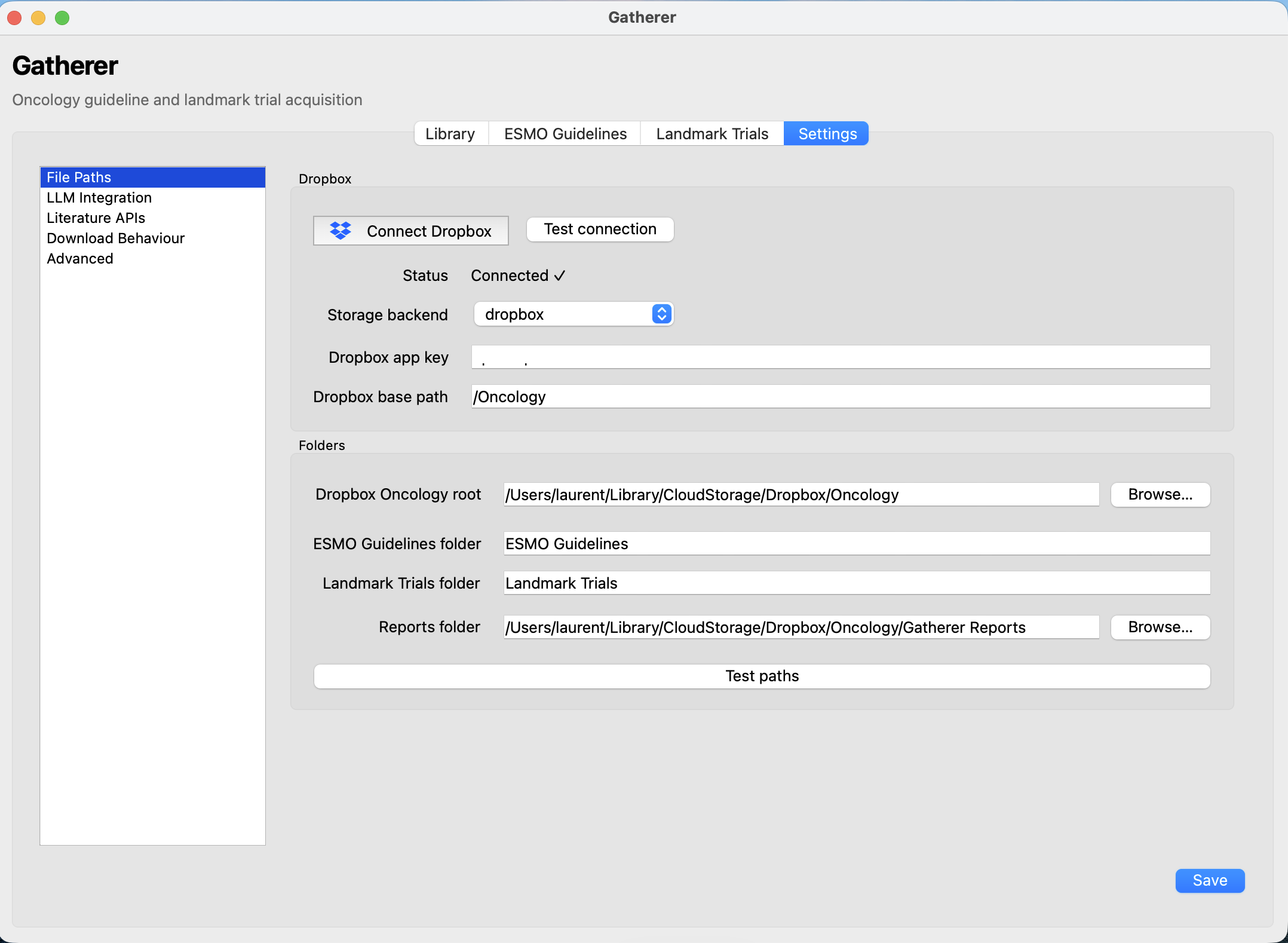
Settings: storage backend and library paths
Settings — storage backend and library folder paths.
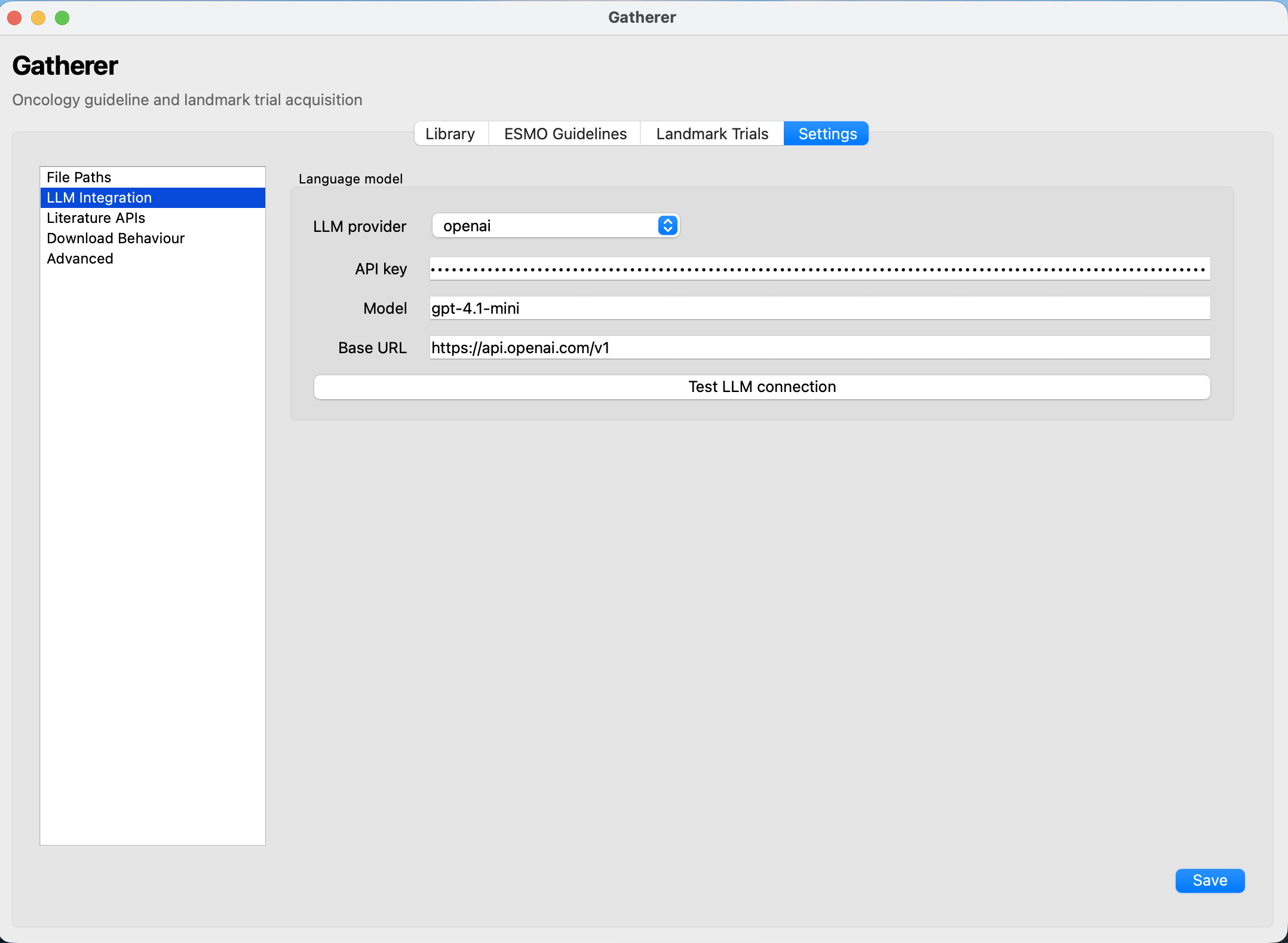
Settings: LLM provider configuration
Settings — the language model that proposes candidate landmark trials for review.

More from the studio